What do Nic Claxton, Norm Powell, Julius Randle, Trae Young, Keon Ellis and Isaiah Stewart have in common?
The new lottery odds.
The decision to acquire each of these players was motivated, at least in part, by the fear of regulation. In years past, teams like the Bulls, Nets, Grizzlies, and maybe the Wizards would have approached this season with one goal in mind: acquire assets.
And actually, nothing about the asset-acquisition goal has changed, it’s just the route to get there. Under the old lottery system, the roadmap to acquire assets was clear for these teams:
- Try to have the worst possible record to increase the chance of acquiring the first pick.
- Make moves on the margins to take on bad contracts in exchange for young players and future picks.
But now teams have an active incentive to not be the worst possible team. Instead, teams want to be the 4th to 10th worst team in the league. That is not a minor difference.
To understand how the new lottery shaped the decisions of these teams, let’s take a close look at the Bulls’ offseason and how the new lottery shifted the Bulls’ incentives.
How the new lottery reshaped the Bulls
To begin, we must look at the Bulls’ cap situation when Bryson Graham took over:
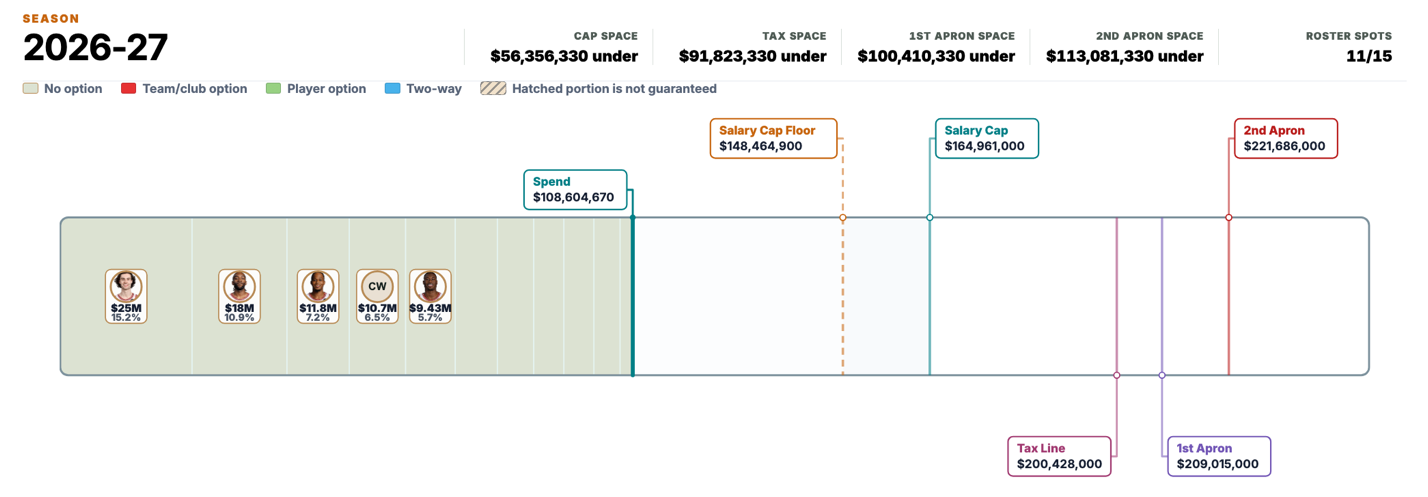
(if you like this graphic or would like to build your own scenarios, check out my cap sheets)
The Bulls had around 56 million to play with in free agency. It’s important to note that the Bulls had to do something as they had to hit the salary floor by the start of the season. The Bulls were left with the two ways to hit the salary floor and build out their roster: in trades and free agency.
Trades
In a trade, the Bulls had four possible incentives:
- acquire players to help win games;
- See: The Jazz trading for Jaren Jackson Jr.
- get assets for being the landing spot of a salary dump;
- See: DFS and 3 seconds to the Hornets
- get young players with potential; and
- See: Bucks getting Ware and Jakucionis
- rehabilitate a player’s value.
- See: Nets (trading Cam Johnson and Mikal for assets and soon MPJ)
Of course, these incentives can work in combination with one another (i.e. the Hornets could think DFS will also help them win games and that his value can be rehabilitated).
In the old lottery system, the Bulls had practically no incentive to make a trade for reason (a)—in fact, the Bulls wanted to make trades that would help them to lose games. The new system tips the scales and incentivizes the Bulls to make a trade to help them win games. That’s exactly what the Bulls did when they traded for Claxton. The Bulls got a player who they thought could help them to avoid relegation and whose value can be rehabilitated.
Well, what would the Bulls have done differently in the old system if they weren’t incentivized to bring in winning players? Isn’t it possible the Bulls still would have done this deal just because they like Claxton and think his value can be rehabilitated?
It’s definitely possible the Bulls still would have done the Claxton deal. Regardless, in the old lottery system, the Bulls would have been more incentivized to find salary dump deals. And there are plenty of salary dump deals out there. We saw salary dump deals for DFS, Caris Levert, Devin Carter, and the OKC guys. There are also lots of salary dumps which could have happened: Jarred Vanderbilt, Jerami Grant, Christian Braun, Dennis Schroeder, and the list goes on. It’s of course impossible to say what any of these deals would have looked like but the point remains: the old system incentivized the Bulls to find guys who would help them lose, not win.
Free Agency
Did the new lottery also change the Bulls’ incentives in free agency?
Yes.
Much like in trades, the Bulls incentives in free agency were:
- acquire players to help the Bulls win games now;
- acquire players who can be flipped for assets later on; and
- sign young players with high upside.
We know that in the old lottery system the Bulls would not be incentivized to get win-now players (incentive (a)). In both systems, the Bulls are incentivized to sign young players and rehabilitate player value (incentives (b) and (c)). The core dominion is that all these incentives effect one another: if the Bulls are more incentivized to pursue win-now players then they are less willing to take risks to acquire young players with high upside. Put simply, it made the Bulls less likely to give a restricted free agent an offer sheet.
For a host of reasons, which could be its own separate article, RFA is frigid. At its core, the team giving an offer sheet (here, the Bulls) doesn’t have control over the outcome of the situation and risk letting other moves pass by while they wait for the other team to match the offer sheet.
The cost of making an offer sheet was high before the new lottery odds but now it’s even higher. The reason is simple: if the Bulls have more pressure to win now then the cost of missing out on other free agents is higher.
Imagine that the Bulls gave Tari Eason an offer sheet and assume that this offer meant that Norm Powell signed with another team. In the old system, the Bulls are not in the best position because other moves have passed them by and they didn’t get Tari Eason, but it’s not the end of the world. In the new system, by losing out on both Eason and Powell, the Bulls have all the costs listed above and an increased risk of relegation.
It’s tough to say with confidence that the Bulls would have given a RFA an offer sheet in old lottery system. However, Tari Eason signed a pretty team friendly deal at 4+1/81.5 (player option), Peyton Watson remains without a team and no one has a lot of cap space, and Mark Williams signed 3/38.
Could the Bulls have pried Mark Williams from the Suns if the Bulls gave him an offer sheet in the 15-20AAV range?
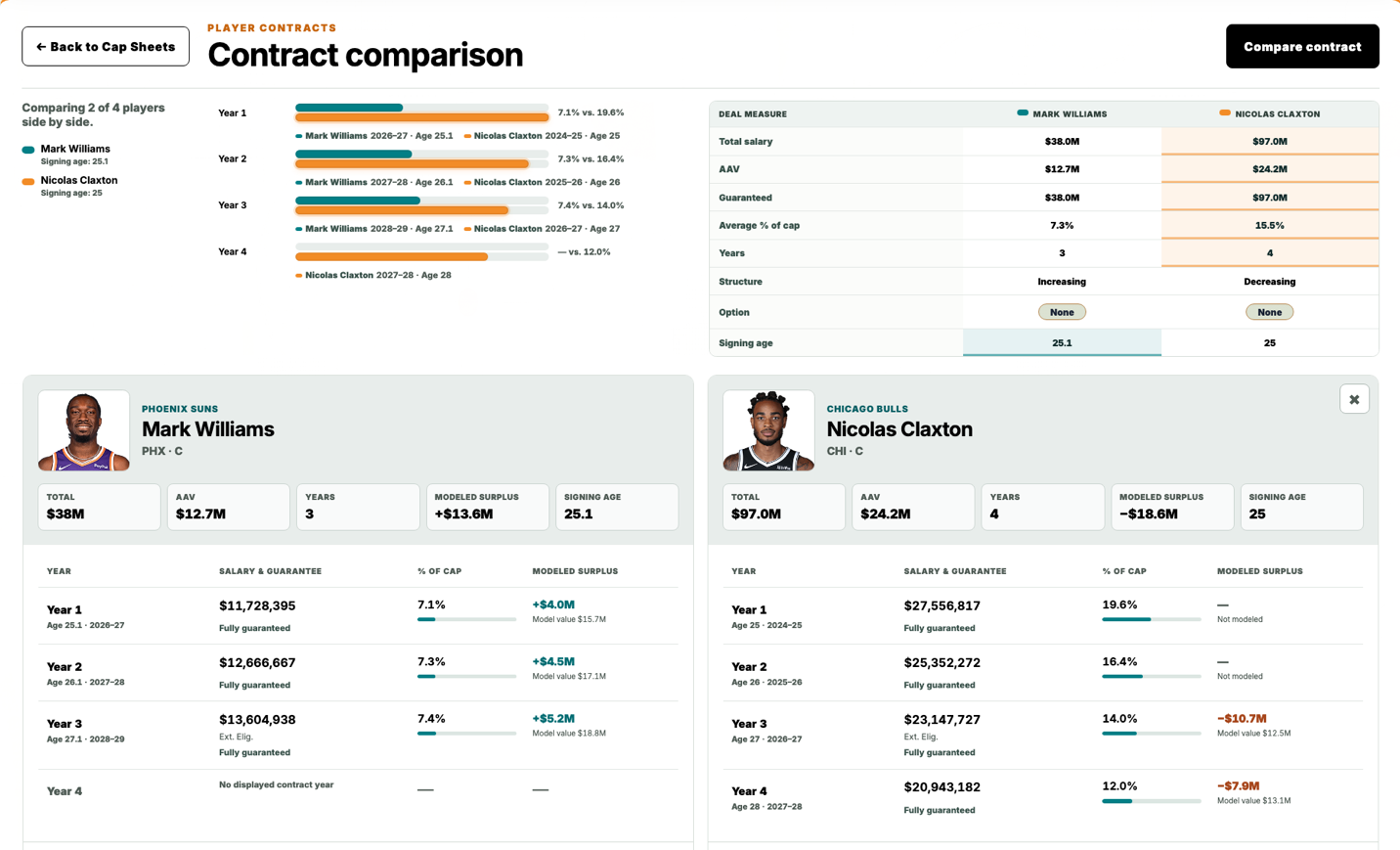
Would it have been unwise for the Bulls to offer Eason a deal in the 25AAV range (which would have created 1st apron issues for the Rockets who are currently about 11 million under the 1st apron but also have 2 roster spots to fill)?
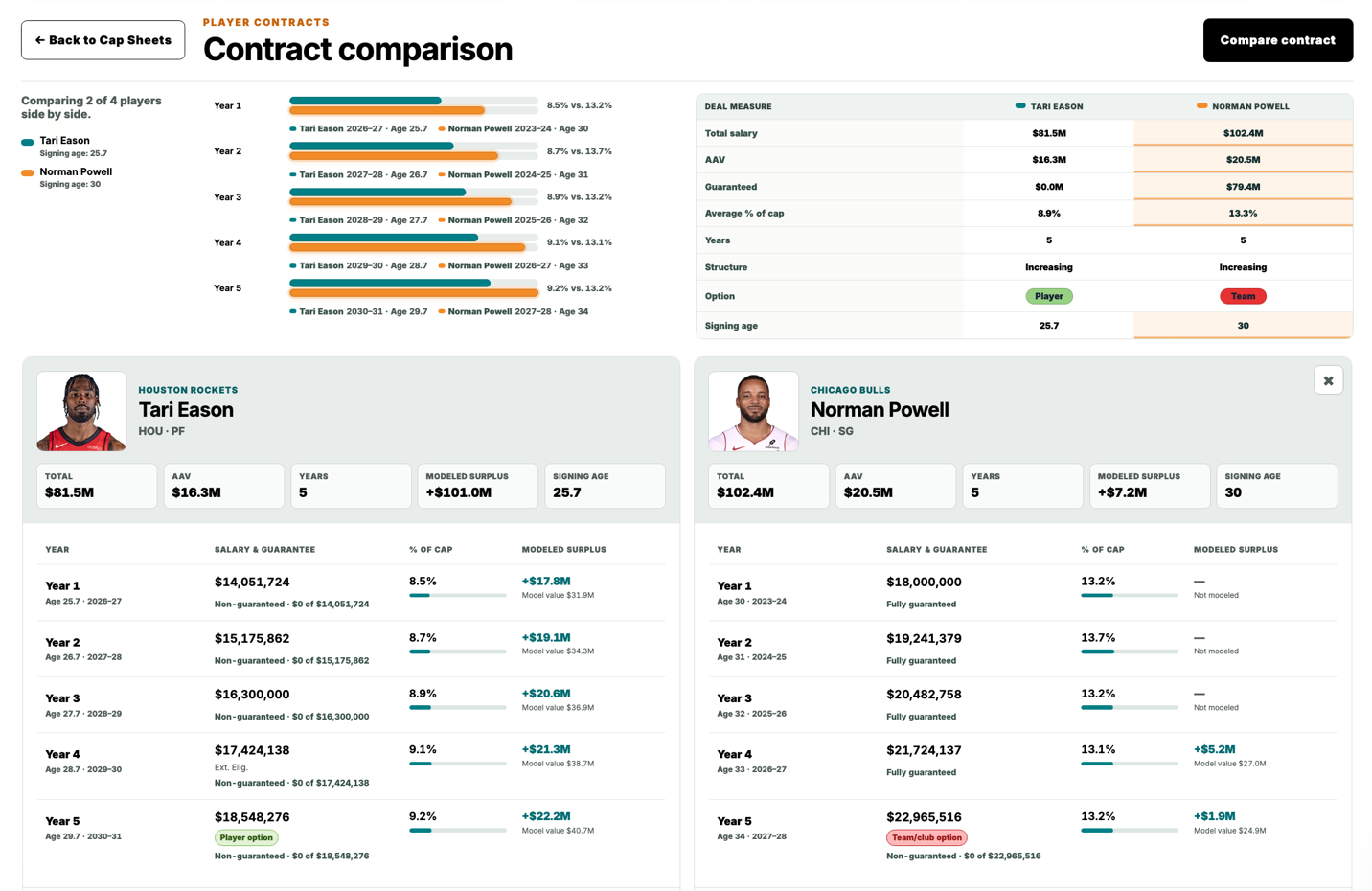
(check out my player contract comparison tool if you like these graphics)
Maybe, even in the old system the Bulls didn’t want to play the RFA game, would they have been more willing to go after non-RFA higher upside players such as Kuminga, Grimes, Day’ron Sharpe, and Ousmane Dieng? What about declining Leonard Miller’s team option and locking him in on a cost controlled long term deal with a decreasing structure?
In the past, the only reason the Bulls would have acquired Claxton and Powell would have been to rehabilitate their value and flip them sometime later. This strategy wasn’t necessarily a bad option, but it did run into tension with the goal of being the worst team. But now, the Bulls have two incentives to acquire Claxton and Powell: it helps them avoid relegation and the Bulls can still flip them.
But should teams even care about relegation?
All the above analysis turns on the assumption that the Bulls really should fear relegation, but should they? There has been a growing view that teams shouldn’t really fear relegation. Take what Steph Noh recently said about the Bulls (shoutout Steph):
“Landing in the relegation zone shouldn't matter much for the Bulls given that the penalties for being at the bottom are not nearly as severe as the marketing around the new lottery odds would have you believe. Their average pick position drops by a little more than half a slot, from 7.4 to 8.0, if they fall into that bottom three.”
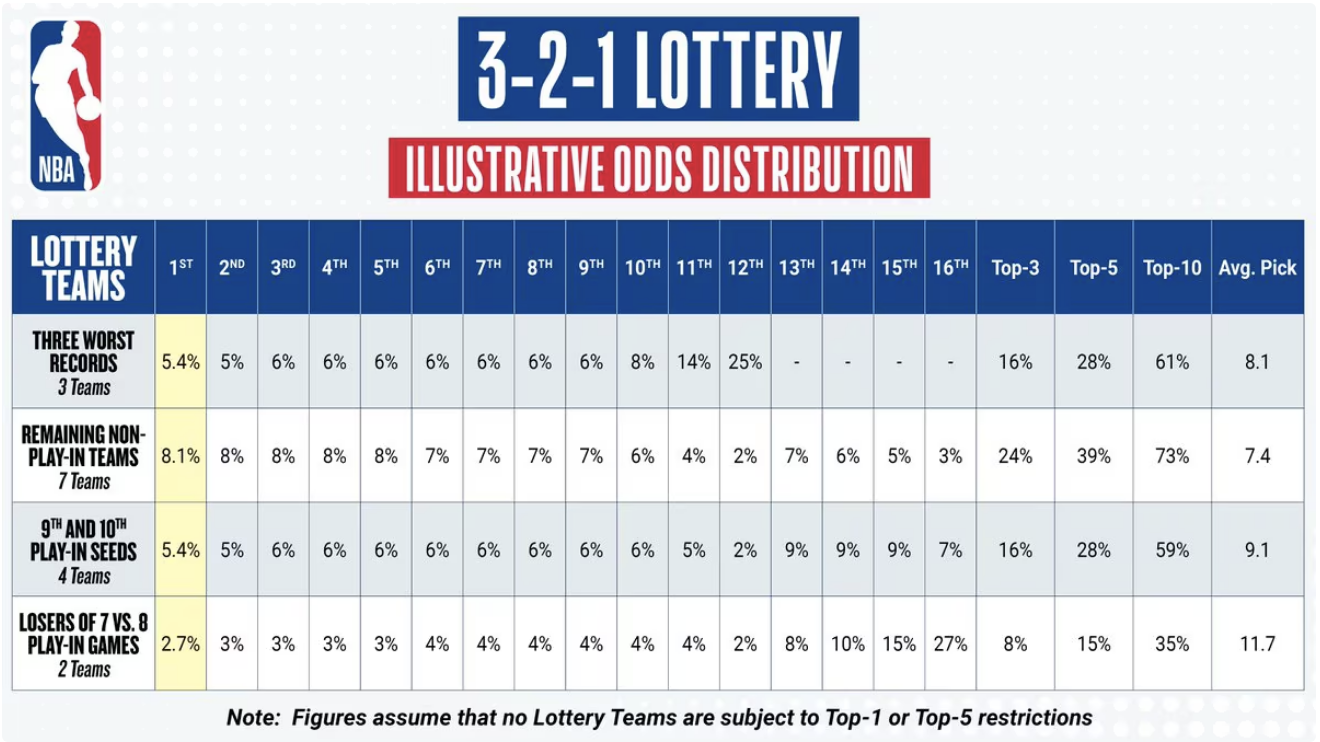
On its face, this take makes a lot of sense: a .6 projected slot drop isn’t very much. The problem with this take is that it fails to consider how the value of picks operates as an exponential function.
The exponential value of picks is both intuitive and backed by the data. Let’s use the 2023 draft (Wemby draft) to think about this intuitively. Which team would you rather be:
| Odds of 1st Pick (Wemby) | Odds of 6th Pick (Anthony Black) | Odds of 7th pick (Bilal Coulibaly) | Odds of 14th Pick (Jordan Hawkins) | ‘Average Pick’ | |
|---|---|---|---|---|---|
| Team A | 50% | 0% | 0% | 50% | 7 |
| Team B | 0% | 50% | 50% | 0% | 6.5 |
I think it’s pretty clear that you would rather be Team A, with a 50% chance of landing Wemby, even if it’s possible Team A ends up on the outside looking in at pikc No. 14. Anthony Black and Bilal Coulibaly are solid players, but their value is nowhere near Wemby’s. Team A has a worse ‘average pick’ yet is actually in a preferable lottery position because pick value is exponential.
It is fair to argue that this example is benefitted by a cherry-picked draft and hindsight, but the data shows that the value of picks is exponential. In 2018, Tony ElHabr wrote a great ebook breaking down various ways data scientists have attempted to find the value of each pick in the draft. Every model agrees, the value is exponential:
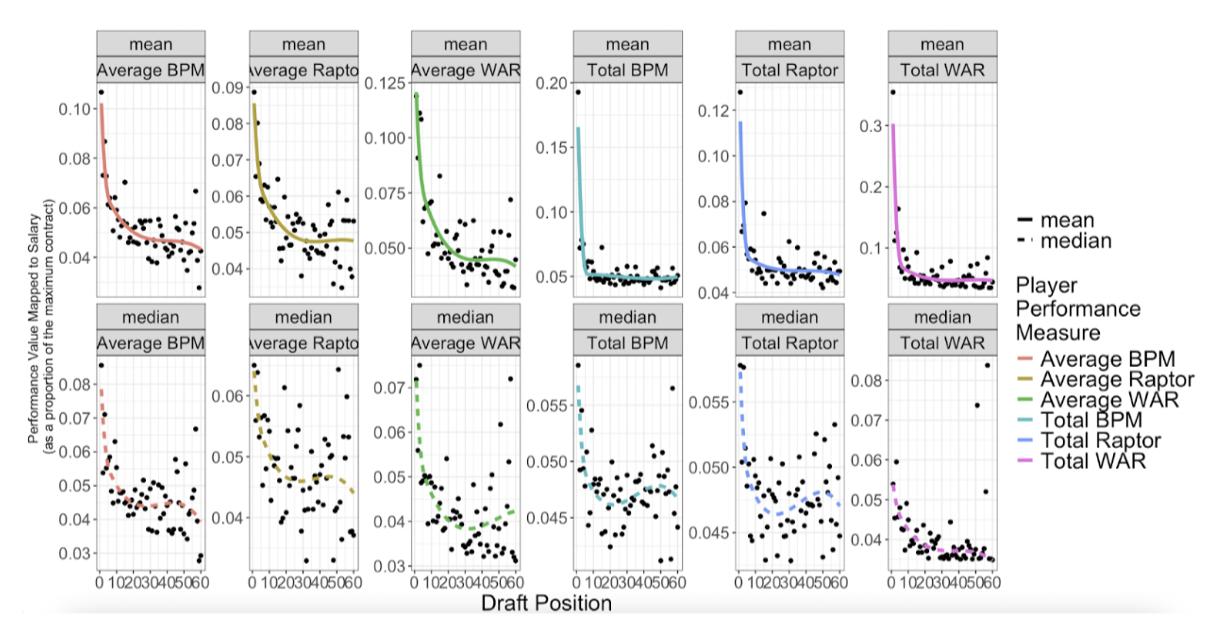
The ‘average pick’ is a flawed way of understanding these new odds because it doesn’t take the exponential value into account. Put simply, if your odds at having the 3rd pick go down 2% that’s worse than your odds at the 5th pick going down 2%. This might sound obvious (you want higher odds on higher picks) but exponential value is always difficult to properly assess.
Tank anyways?
Despite this exponential curve, there is still an argument for why teams shouldn’t fear relegation. Even if the value of picks is exponential the percentage difference is still minor enough that teams shouldn’t close themselves off from the ways that abject tanking enables asset acquisition (woah lots of buzz words).
Let’s continue to use the Bulls as an example. Imagine that the trade deadline is coming up and the Bulls are in the relegation zone, but they could reasonably escape the relegation zone either by becoming buyers at the deadline or staying pat with their current squad. Then, a contending team calls the Bulls saying they are looking to acquire Norm Powell and/or Nic Claxton. The contending team would want to send back bad money but would be willing to include a future pick or swap in the deal. Should the Bulls hang up the phone simply because becoming sellers casts their ticket to relegation?
No.
To explain, let’s assume that the following hypothetical:
- The Bulls know for sure that becoming a seller means they will be relegated.
- The Bulls are offered a future pick that will come from the losers of the 7 v. 8 play-in game this season.
- Claxton and Powell are not a part of the Bulls’ long-term plans
- Finally, the ‘bad money’ player the Bulls will acquire in the trade will be a free agent in the summer.
Under these conditions, the Bulls should absolutely accept the trade.
First, the Bulls odds of acquiring a top pick would be the same as if they had not been relegated:
- Relegated odds of 1st pick= 5.4% (Bulls own pick)
- Play-in odds of 1st pick= 2.7% (Newly acquired pick)
- 5.4%+2.7%=8.1%
- ‘Non-relegation’ odds of 1st pick=8.1%
Second, in this world, the Bulls get two lottery picks rather than just one.
In this situation, relegation is not a big enough punishment to incentivize the Bulls to avoid it.
The issue with this example is that it oversimplifies a situation that’s latent with uncertainty. The Bulls would never know that the pick would be play-in loser’s pick. Additionally, a lot of the time these picks are traded in future drafts where teams don’t know who is going to be available. Having greater odds at the 1st pick in the Wemby draft is a lot more valuable than in the Risacher draft– and who knows whether the 2032 class will look more like Wemby’s or Risacher’s.
Despite the oversimplification, the broader point still stands: if the deal is juicy enough, it’s worth it for a team to fall in the relegation zone.